
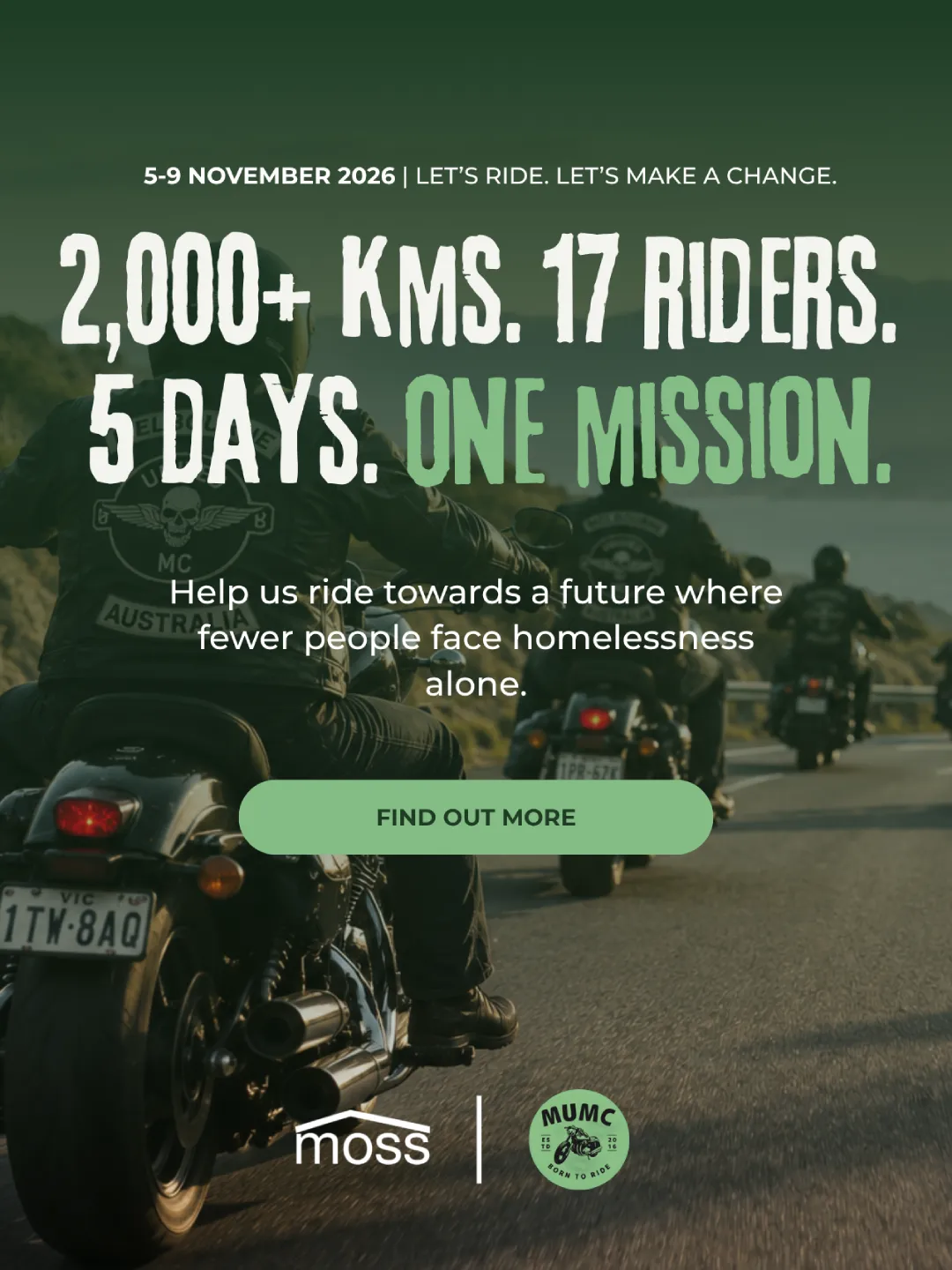

It’s a warm November morning in Melbourne. The sun is up early, the jacarandas are out, and 17 motorcycles are lined up and ready to go. Ahead of them is more than 2,000 kilometres of Victorian road: coastal highways, country towns, long stretches of gold paddocks and plenty of stops for servo coffee.
The riders from the Melbourne United Motorcycle Club aren’t doing this for a holiday. They’re riding to raise money and awareness for people experiencing homelessness and housing insecurity. Their goal is simple and ambitious: make every kilometre count.
Every dollar raised goes to MOSS (Merri Outreach Support Service), a not-for-profit housing support service that has stood beside vulnerable Victorians since 1989. If you’ve ever walked past someone sleeping rough and wondered how you could help, this is your chance.
A bigger story than the one we see
Most Melburnians have seen it: a swag in a CBD doorway, a sleeping bag under a suburban bridge, a car with fogged-up windows parked in the same spot every night. Rough sleeping has become more visible in the city, the suburbs and regional towns.
But what we see on the street is only a small part of the story.
The Australian Bureau of Statistics counts someone as homeless if they don’t have safe, secure and adequate housing, not just if they’re sleeping outside. That includes people:
- sleeping in tents, cars or makeshift shelters
- staying in crisis accommodation
- couch surfing with friends or relatives
- living in boarding houses or other temporary lodgings
- living in severely overcrowded homes
On Census night in 2021, around 122,494 people in Australia were homeless, an increase of 5.2% since 2016.
Victoria’s share is large. The Council to Homeless Persons reports that 30,660 Victorians were without a home at the last Census. That’s about 27% of the national total, roughly enough people to fill Rod Laver Arena twice! Most of them weren’t sleeping rough. They were hidden from view in temporary, insecure or crowded places.
Those figures are the latest official numbers, but they’re five years old. The 2026 Census results will take time to come through, and the 2021 count was taken during the pandemic, when eviction moratoriums and emergency accommodation probably kept some people off the streets. Many people in the sector expect the true picture today to be tougher. That’s a reasonable expectation, but the new data will confirm it.
It could be any of us
The most striking number isn’t how many people are homeless now. It’s how many people just like you or me are close to it.
Responding to the Productivity Commission’s 2026 Report on Government Services, Mission Australia has warned that up to 3.2 million Australians could lose their home after just one life shock, such as a rent increase, a job loss or an eviction.
That’s the reality of the cost-of-living crisis, and many people will recognise it.
Think of someone renting in Melbourne’s north. Her lease is renewed with a rent increase that’s become all too normal. She was already spending more than half her pay on rent. So she cuts back on groceries, puts off the car service and lets the power bill slide a little. Then her shifts are cut. Or her relationship ends. Or she’s sick for a few weeks. With savings, she’d get through it. Without them, she’s suddenly sleeping on a friend’s couch.
It’s not something we can just blame on one bad decision. More often, several hard things happen at once: family breakdown, family violence, illness, job loss, ageing out of care. Family violence is a major cause for women and children, because leaving an unsafe home often means leaving the only home they can afford.
The good news is that early help works. Keeping someone in their home is usually far easier, cheaper and better for them than helping them rebuild after losing it. That’s why support at the right moment matters so much.
Services stretched thin
Specialist homelessness services are the frontline teams who provide crisis help, case management and pathways back into housing. The Productivity Commission reports that governments spent $1.8 billion on these services nationally in 2024–25, or about $64 for every person in Australia.
Demand is still enormous, with a further 273,600 people outside of those counted in the Census sought help from homelessness services. This includes 2,158 supported by MOSS ain 2025 alone. Workers across the sector say there are rarely enough affordable homes for people to move into.
It’s worth being clear about what donations can and can’t do. Housing supply, rent prices, social housing and income support are bigger questions for governments and the market. A fundraiser won’t solve those on its own. What community support can do is keep people fed, safe and connected now, and help them hold on to the homes they already have. For the person getting that help, it makes a huge difference.
Meet MOSS
Based in Melbourne’s north, MOSS has spent more than three decades helping men, women and children through some of the hardest times of their lives.
Our mission is clear:
The work is practical and personal. MOSS provides food and material aid, crisis support, help finding and keeping housing, and outreach that goes to people where they are instead of waiting for them to come in. For someone who’s been let down before or is juggling health problems, someone who keeps turning up for them can be what rebuilds trust.
MOSS also works with local councils. A partnership with Merri-bek council created a dedicated support service for people experiencing homelessness in the area. It’s a good example of what happens when local organisations and councils work together.
Underneath all of it is a simple principle: everyone deserves to feel welcomed, connected, involved, secure and supported. That isn’t fluffy. People who feel judged stop asking for help. People who feel respected come back, and coming back is often where things start to change.
Why bikes and big hearts go together
Motorcyclists and charity work might seem like an unexpected match, but they go together more often than people think.
Motorcycle clubs are built on mateship. You look after your crew, you don’t leave anyone behind on the road and you turn up when it counts. Riders across Australia have a proud history of toy runs, hospital fundraisers and mental health rides. The Melbourne United Motorcycle Club is putting that same loyalty behind people who too often go unseen.
The route matters too. More than 2,000 kilometres takes the message well beyond the inner city, into suburbs and regional towns where rising rents and limited services are hurting people, often without much attention. A convoy of 17 bikes rolling into a country town on a sunny afternoon gets noticed. People ask questions. Conversations start at the pub, the bakery and the petrol bowser.
There’s also the effort involved. Long days on the bike, building heat, sore backs and early starts. The riders are putting in the hard yards, and that sort of commitment tends to inspire other people.
How you can join the ride (no bike needed)
You don’t need a licence, leathers or a sore backside to be part of the MUMC charity ride! Here’s how you can help.
Chip in. A donation helps MOSS keep providing food, housing support, crisis assistance and connection to people who need it. And all donations over $2 are tax deductible. Whether it’s the cost of a tank of fuel or a regular monthly gift, it all adds up. Ongoing donations are especially useful because they help the team plan ahead. Just make sure you give through MOSS’s official channels.
Follow along and share. Track the riders’ progress, cheer them on and share their updates. Every share puts the cause in front of someone new, and that could include someone who’s quietly struggling and doesn’t know help is available.
Start a conversation. This one costs nothing. Next time someone says homelessness “happens to other people”, mention the 3.2 million Australians who are one shock away from losing their home. Talk about the couch surfers, the families squeezed into crowded homes and the older women sleeping in cars. Less stigma means more people ask for help early, when it’s most effective.
Know who to call. If you or someone you know is at risk of losing their home, reach out early. Local services such as MOSS and the Council to Homeless Persons can help point people in the right direction.
Bring your business on board. Local businesses can help get the riders, and the cause, over the line. Sponsor a leg of the journey or a set number of kilometres, match your staff’s donations, or pop a donation tin or QR code on the counter. If the convoy is passing through your town, offer a fuel stop, a coffee or a friendly welcome. Housing stress affects staff, customers and neighbours too, so backing early support helps keep your whole community strong.
Rally your club or group. Footy and netball clubs, Rotary and Lions, schools and social teams are all great at showing up for each other. Hold a sausage sizzle, trivia night or raffle, or set your own 2,000km challenge by walking, running or cycling as a team. Turn out with signs when the riders roll through and share the campaign in your newsletters and group chats. Clubs are often where people first notice someone is doing it tough, so the more you talk about it, the more likely they are to get help.
The road ahead
When the ride ends, the riders will park their bikes, stretch their legs and probably enjoy a well-earned cold drink. The housing crisis won’t be fixed by then. Rents will still be high, new Census numbers will eventually show how much has changed, and debates about housing supply will continue.
But between those big debates and someone’s next night’s sleep, there’s a lot of room to make a difference. That’s where MOSS works: a meal today, a caseworker who calls back, and a plan to stay housed or find a home again. That work depends on people who care enough to get involved.
17 riders are giving their time, energy and more than 2,000 kilometres of road to the cause. The rest of us can back them up with a donation, a share or a good conversation, and help turn their ride into real community impact.